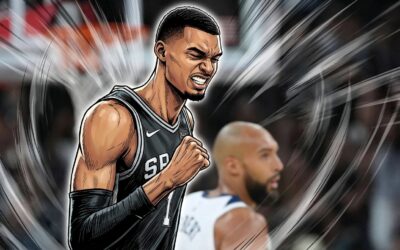
139-109. At home. In a clinching game where Victor Wembanyama didn’t even need to go nuclear — he played 27 minutes, scored 19 points, and watched Stephon Castle (32 points, 11 rebounds) and De’Aaron Fox (21 points, 9 assists) do the heavy lifting. The Spurs didn’t need Wemby to close us out. That’s the part that should keep the front office up at night.
The series is over. Minnesota goes home. Karl-Anthony Towns goes to the conference finals.
Let that — wait, we don’t do that here. KAT is in the conference finals with the Knicks, and we’re left staring at the return from the September 2024 trade like it’s a gas station sushi roll we bought because we were starving and it looked fine in the wrapper. Julius Randle averaged 12.8 points on 34.2% shooting across six games against San Antonio. He scored 3 points in Game 6 on 1-of-8 shooting in 24 minutes. THREE. The man who was supposed to add playoff toughness to this roster went 1-for-8 while Ant was grinding out 24 points on a night where the game was already gone by halftime.
And Donte DiVincenzo — the other named piece in the trade — tore his Achilles against Denver in the first round and never played a single minute against the Spurs.
The Spurs made it official:
SERIES W!!! pic.twitter.com/OxH2AHR6uK
— San Antonio Spurs (@spurs) April 29, 2026
San Antonio is heading to the Western Conference Finals. Minnesota is figuring out what to do with $33 million in Julius Randle and a roster that just got exposed at the position it could never fix.
Here’s what the KAT trade was supposed to solve, and why this framing matters beyond simple “we miss KAT” revisionism. The trade’s surface logic wasn’t crazy. Towns’ defensive limitations were documented and genuine — you could build a real case that his inability to guard pick-and-rolls was a ceiling on this team’s playoff potential. The salary math worked. Randle as a physical, switchable 4 who could score in the post and handle playoff minutes made sense on paper as a complement to Anthony Edwards and Rudy Gobert. The piece the front office thought it was buying was a player who’d been a 20-plus scorer for four straight years in New York.
What Minnesota actually got was the Knicks fans’ worst nightmare version of Randle — the one who disappears when the margin shrinks and the scheme tightens. The Spurs played him as a non-shooter from three (and he obliged, shooting 19%) and dared him to create off the bounce against a defense that’s designed from the ground up to funnel everything toward a 7-foot-3 shot-eraser. Randle had no answer. This was not a matchup he was built to win, and no amount of regular-season point totals changes what the tape showed across six games.
Wembanyama’s series arc told the real story. He set an NBA playoff record with 12 blocks in Game 1 — a Wolves WIN — then came back in Game 3 with 39 points, 15 rebounds, and 5 blocks on 72.2% shooting, a line ESPN compared to Olajuwon, Shaq, and Kareem. After getting ejected in Game 4, he came back in Game 5 with 27 points, 17 rebounds, 5 assists, and 3 blocks. The Wolves spent all week trying to break Wembanyama’s brain — and he responded by treating Game 5 like a homework assignment he finished in 20 minutes before dinner.
Minnesota had no answer for the size, the passing angles from the high post, or the way he collapses the floor for Castle and Fox. Not because they lack effort. Because the trade they made in 2024 didn’t address that specific kind of problem — it assumed a West that existed twelve months ago, not the one San Antonio has built around a once-in-a-generation talent.
Ant was not the problem. He was good enough in this series — 23.6 points per game on 50.6% shooting through five games before a cold Game 6 — and the crisis around this team was never about him. It was always about whether the pieces around him could hold up when the pressure arrived. They couldn’t. Randle folded. DiVincenzo was on a training table. The Wolves went into a series against the most physically imposing center in the game and their best weapon against him was a prayer.
KAT this season for the Knicks: 20.1 points, 11.9 rebounds, and shooting just north of 62% through the playoffs. The trade isn’t simply a mistake in hindsight — the full truth is more uncomfortable than that. It’s that Minnesota gave up a player who had a ceiling and got back a player who found one faster.
The offseason questions now write themselves. What happens to Randle? What does this team actually look like it’s building toward? And is the front office willing to reckon with the fact that they assembled a roster for a West that already moved on?